Projekt
DESIGN OF AN INTEGRATED SPATIOTEMPORAL DEEP LEARNING FRAMEWORK FOR AUTONOMOUS PRECISION WEED DETECTION, TREATMENT, AND RECURRENCE PREDICTION IN DRONE-BASED SMART FARMING SETS
Uncontrollable weed growth and weed-to-crop differentiation impacts directly crop yield and resource effectiveness. In precision agriculture, effective and sustainable weed management therefore remains a crucial aspect. While conventional aerial imaging techniques, often restricted to a single date acquisition and sta…
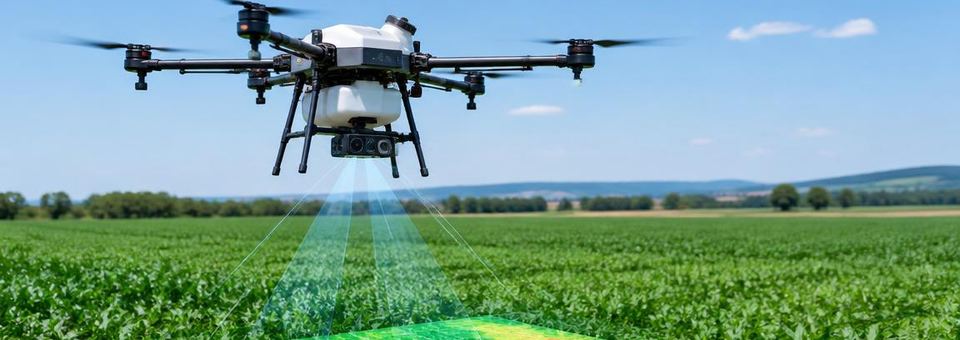
Uncontrollable weed growth and weed-to-crop differentiation impacts directly crop yield and resource effectiveness. In precision agriculture, effective and sustainable weed management therefore remains a crucial aspect. While conventional aerial imaging techniques, often restricted to a single date acquisition and static spectral analysis, are not favorable for accurate differentiation of weeds and crops across different growth stages, leading to high false positives, inefficient spraying, and wastage of herbicides; therefore, the current research attempts propositional limitations to address an integrated approach to multi-stage precision weed management from spatiotemporal data fusion, context-aware deep segmentation, and adaptive treatment optimization. The entire pipeline starts with Adaptive Multispectral-Spatiotemporal Fusion (AMSTF), whereby spatial-spectral features from multispectral imagery are fused through temporal growth patterns using repeated drone flights to gain improved reliability for detection with less false positive instances. The probability maps generated are then refined by Context-Aware Multi-Scale Deep Weed Segmentation (CAMDWS), a dual-branch CNN that captures micro-scale leaf texture as well as macro-scale patch distribution for more precise weed boundaries. The outputs of segmentation are forwarded unto Autonomous Weed Treatment Path Optimization (AWTPO), which uses modified Dijkstra graph optimization to establish fuel, battery, and payload-efficient drone waypoints. The optimized flight plan feeds into Variable-Rate Micro-Droplet Weed Neutralization (VRMDWN), allowing species-adjusted targeting for specific droplet sizes and flow rates for herbicide application. Finally, Post-Treatment Weed Recurrence Prediction (PTWRP) uses reinforcement learning of images obtained after spray and historical patterns for recurrence risk, facilitating proactive micro-treatments. Experimental evaluations indicate an improvement in the range of 6-8% in detection accuracy, 18-22% gain in spraying efficiency, and a reduction in herbicide use of up to 32%. Such a holistic approach would make weed-crop discrimination, thereby minimizing chemical wastage while introducing a predictive long-term sustainable weed suppression strategy for yield protections.
Technologien
- Maschinelles Lernen Maschinelles Lernen – Überblick über Forschungsprojekte, Patente und Akteure im TechnologieAtlas.
- Batterietechnologie Batterietechnologie – Überblick über Forschungsprojekte, Patente und Akteure im TechnologieAtlas.
Themengebiete
- Klima und Umwelt Klima und Umwelt – Überblick über Forschungsprojekte, Patente und Akteure im TechnologieAtlas.
- Landwirtschaft Landwirtschaft – Überblick über Forschungsprojekte, Patente und Akteure im TechnologieAtlas.
Hochschulen
- Yashwantrao Chavan Maharashtra Open University Yashwantrao Chavan Maharashtra Open University – Hochschule bzw. Forschungseinrichtung mit Aktivitäten in For…